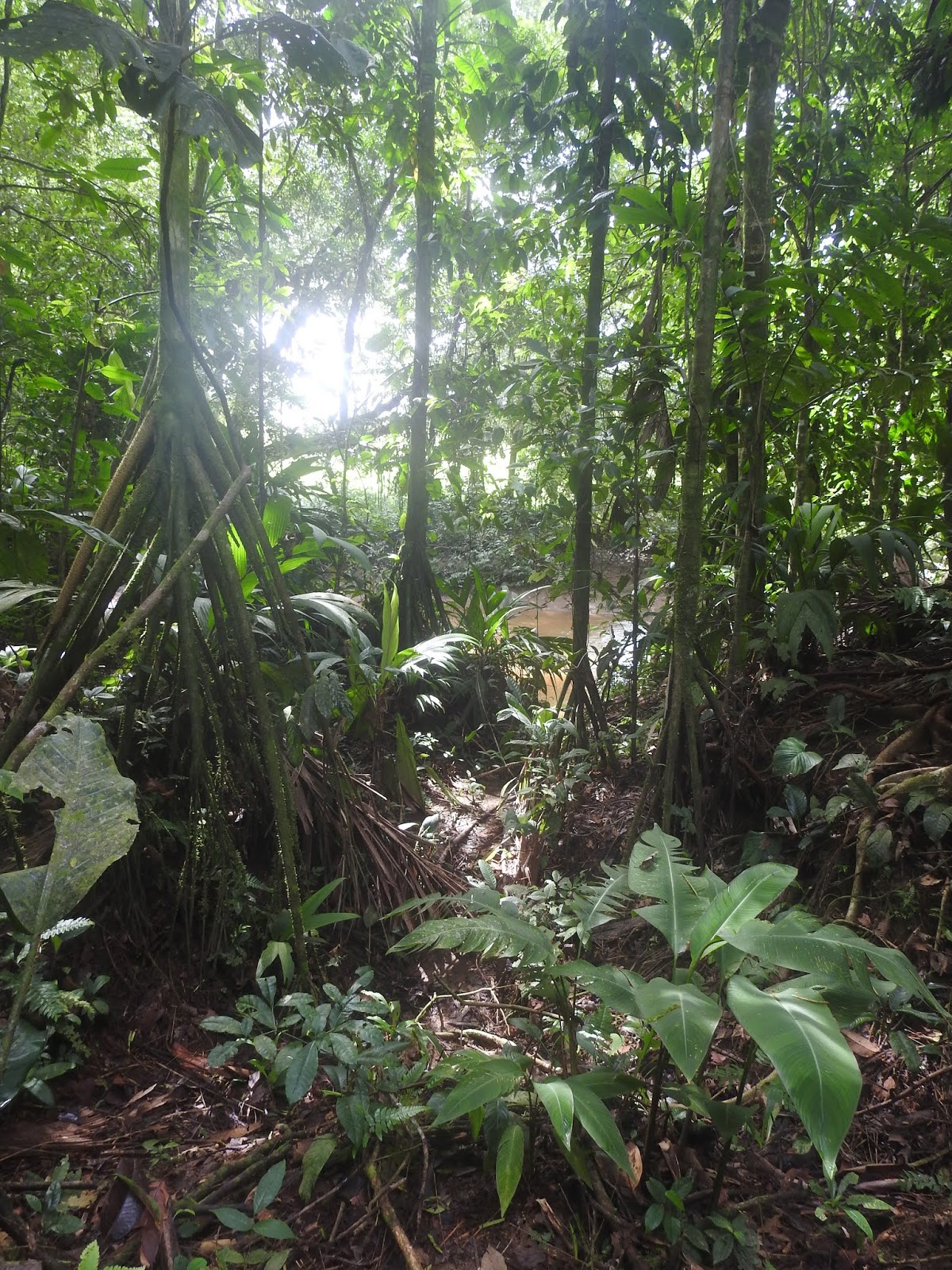
I have never been much of a risk taker. So why did I decide to join colleagues and friends last year to form an official organization in Costa Rica (equivalent to an LLC), invest in the acquisition of 500 acres of rainforest in a remote part of the country, and support the establishment of a new field station for education and research – the Camaquiri Conservation and Initiative? I suppose the answer is complex; saying that it seemed like the right thing to do doesn’t quite explain the decision.
Dave and I first visited Costa Rica in the early 1990’s as part of a tour group through Voyagers (a travel company). My good friend and colleague from East Stroudsburg University, Terry Master, was with us. I remember being in awe as we toured Poás Volcano, Monteverde, and the Osa Peninsula. I also remember seeing a lot of deforestation – scenes reminiscent of the photos in the textbook I used for my environmental science course. But the beauty and biodiversity were unlike anything I had experienced before.
I didn’t get back to the country until 2000 during a sabbatical. Terry and I visited a number of places to consider possibilities for teaching and research. There are several good stories from that trip that include my being in a back brace due to a vertebrate fracture (yes, a broken back), getting lost on the slippery slopes of near Paraiso Quetzal Lodge in the Cerro de la Muerte (“Mountain of Death”) region of the country, and trying to drive a two-wheel white truck over dusty dirt roads, over boulders and across creeks. Picture the two of us trying to build a temporary log bridge (yes, with me in a back brace)!
 |
| The Respendent Quetzal - photo taken in the Cerro de la Muerte region in 2019 |
During that trip, we spent some time at the
La Suerte field station. I don’t think I had ever experienced such humidity! Back then, we still used film cameras and I had two rolls of film snap from the moisture. I distinctly remember seeing my first eyelash viper (a gorgeous lime green one -- up high in a tree, so I was safe) and a sloth that had come down from the treetops to do his or her weekly “business.”
 |
| A sloth doing what sloths do |
At the time, two teenagers were working at La Suerte – Ernesto Carmen and Israel Mesen. I was struck by Ernesto’s amazing birding skills and his research-focus; little did I know that my son Corey (who was only 5 at the time) would soon have similar interests and talents. Ernesto’s family has a shade-grown organic coffee farm or finca,
Café Cristina – a now favorite destination for my course and my favorite coffee. I had no idea at the time, that Israel, who didn’t yet speak English, would become my course guide (through
Tayra Educational Expeditions), a dear friend, and a business partner with Camaquiri.
 |
| Linda Moyher from Cafe Cristina explaining shade grown coffee techniques |
 |
| Israel Mesen |
After that sabbatical trip, I realized that a) I needed good binoculars (Dave got me a pair of Swarovskis that year for Christmas) and b) I needed to go back. I have returned to the country several times with my former colleagues from ESU when they taught courses in tropical ecology. For three of those trips, Corey or Joren came along so were introduced to the tropics at an early age.
 |
| Three of the Husics enjoying Costa Rica (December 2019) |
Dave also joined the ESU group once and Joren spent almost 3 months in the country during his gap year between high school and college. Suffice it to say, the Husic family has come to love the country, it’s amazing biodiversity, and the people (Ticos).
 |
| Long term buddies: Two of the Husics with Terry and Sally Master in front of one of the very large trees at CCI |
Eventually, I decided I could do my own course there, and each year since 2016, I have brought a group of students from
Moravian College to Costa Rica as part of a course entitled
Costa Rica as a Model of Sustainability and Tropical Ecology. Israel is my in-country logistics person and usually my trip guide.
 |
| The 2018 class at Earth University |
 |
| At Arenal in 2017 |
Terry, Israel, others from ESU and I joked for years about having our own place in the country. In January 2016, Corey and I flew down to join our long-time friends to check out a parcel of land that was for sale, but it didn’t feel like the "right" place. For a few years, we heard that Mrs. Heide Vietor Luerssen, now in her 80’s, was thinking of selling her beloved property so she that could return to her home country of Germany. Heide left Europe when she was young, traveled through South American, ended up in Costa Rica, married and with her husband, formed Fibras Tropicales Sociedad Anonima. Through this company, they owned 500 acres of exquisite rainforest near the
El Zota Biological Field Station – a place that I typically brought my students and had visited for years. In March 2018, my students and I visited Heidi’s property. After falling in love with the site (and with Heidi), they spent the rest of the semester working on a draft business plan to try to convince Moravian to invest in the property! I recently found this document; I had forgotten that they had dubbed their proposed company and the property as Lagunas Azules.
 |
| Heidi's house (March 2018) |
|
|
 |
| Seeing Heidi's property (now CCI) for the first time in 2018 |
 |
| Along the road to Heidi's property (now CCI) |
That summer, Dave and I joined some of the ESU gang, Israel, and his relative Ernesto on an expedition to Panama to seek out the rare Harpy Eagle and spend time in the remote
Darién. Over meals, we again talked about buying land in Costa Rica and Heidi’s property was of particular interest since she had returned to Germany. Israel indicated her concern for protecting the forest and his for keeping squatters off the land.
 |
| There are big trees in Panama too! Terry and Tom (on far left) and Israel and Eduardo (on far right) are co-investors in Camaquiri. |
 |
| Our accomodations - Not exactly a 5-star hotel! |
Fast forward to March 2019, when I found myself in the lobby of Hotel Aeropuerto in Alajuela, Costa Rica signing legal documents at midnight to form a new company
Camaquiri Conservation Initiative Sociedad Anonima.
Terry, Tom LaDuke, Jennifer Lansing, Israel and Eduardo – my friends and colleagues – are co-investers. We are joined by the Brink family who purchased a share in honor of
Gavin Brink who loved Costa Rica, herps, and Israel, but sadly, died too soon of multiple sclerosis. (Joren hung out with Gavin when he was at El Zota during his gap year.) Our new company is in the process of purchasing Heidi’s property (through what is essentially a land contract arrangement over 8 years). It still seems hard to believe that we really did this!
 |
| The December 2019 CCI board meeting with the lawyer |
 |
| The Brink family with Israel |
Working with local community members, Israel and Ernesto and the team managed to complete construction of a kitchen/dining area, 6 cabins and a laboratory/classroom on the property in about 6 months – despite heavy rains and other setbacks. Our recent Christmas '19/New Year 2020 trip down there was to officially open Camaquiri!
 |
| The Comedor at Camaquiri |
 |
| Another view of the Comedor |
 |
| The cabins, the mud, and investor Jen |
 |
| A closer view of the cabins |
We had a celebratory dinner with the workers and community members – our new neighbors. We met the chief of police and the manager of the regional conservation district. Both welcomed us and pledged to help us protect the land. I cannot imagine a better team of friends and colleagues to work with on this new adventure.
 |
| The CCI investors and staff |
 |
| Planting a tree of life in memory of Gavin Brink |
 |
| Happy investors! |
 |
| Some of the CCI staff and neighbors |
 |
| More neighbors and staff |
|
 |
| A different type of neighbor |
For years to come – god willing – I will be able to bring my family, students, and colleagues to Camaquiri so they can experience this wonderful place: being woken up at 4:15 AM by Mantled Howler Monkeys, to get wet and muddy, to search for exotic birds in the morning and tree frogs by headlamp at night. I get to return in about 6 weeks and can’t wait to share this place with the 2020 class!
 |
| One of the lagoons at Camaquiri |
 |
| A Broad-billed Motmot - just one of the extraordinary birds of Costa Rica |
|
 |
| A Green and Black Poison Dart Frog |
 |
| One of many species of tree frogs |
 |
| A King Vulture |
 |
| A Howler |
My journey from being trained as a biochemist to someone who teaches courses in tropical ecology, sustainability, and climate change, works in environmental and conservation policy, and now as an investor in a field station in Costa Rica, is a bit unusual. But that journey has been incredibly rewarding. I am constantly amazed at the progress Costa Rica has made in reforestation since my first trip there and in conserving land and establishing national parks (the system of National Parks and Reserves covers an area of 1342 hectares or 25.6% of the land area of the country). The country has bold plans to have zero emissions by 2050 (to decarbonize) after meeting their 2021 goals of net carbon neutrality and eradicating single-use plastic. In 2019, legislation was signed that prohibits the import, marketing, and distribution of polystyrene (Styrofoam) containers throughout the country. A model of sustainability for sure!
After years of teaching students about the environment, I often feel a bit guilty that I haven’t done more – to be more sustainable and to reduce my carbon footprint (I travel a lot). I am also at that age where I wonder what my “legacy” will be – not so much in terms of that big scientific discovery or achieving some level of professional stature – but rather, something that my sons will be proud of. Protecting a chunk of valuable rainforest seems like a start.
 |
| Some wonderful orchids |
The Caribbean lowland of Costa Rica gets a lot of rain. There are a lot of bugs, spiders, and snakes. And there is mud. Lots and lots of mud, el barro, el lodo. I have fallen in it more than once. Nothing a cold shower can’t fix.
 |
| Did I mention the mud? |
But the country is characterized by intense beauty, varied landscapes and geography, incredible biodiversity, and people who welcome gringos into their small communities. I feel at peace when I am there. It is no longer so remote that I can’t remain “connected” via the internet (that may not be a good thing), and the field stations are now connected to the electric grid instead of generators (which wasn’t the case just a few years ago). It is a place to temporarily forget about the day to day grind and the political battles back home. I try to imagine how brave and adventurous Heidi must have been leaving Germany decades ago and eventually ending up in Costa Rica. I can’t possibly know the place as well as she does after living in the country for so long, but I can certainly understand why she loves it so. It is an honor to be able to continue to preserve her land, forest, river, lagoons, and animals.
 |
| One of the many species of Heliconia |
 |
| View from the river trail |
 |
| Family and Friends |
 |
| Tom with his kids! |
 |
| Israel with "BamBam" and Gavin's tree |